
Louisiana Flag: The Story Behind the Pelican State’s Banner
Every state flag tells a story. Louisiana’s tells a slightly bloody one — literally.
At the center of the Louisiana flag sits a mother pelican, wounding her own chest to feed her three chicks. It looks dramatic because it is dramatic. And once you know the backstory, you’ll never look at this flag the same way again.
This article breaks down everything worth knowing about the Louisiana flag: its design, its meaning, its long and slightly chaotic history, and where you can see it (or grab a free image of it) today.
What Does the Louisiana Flag Look Like?
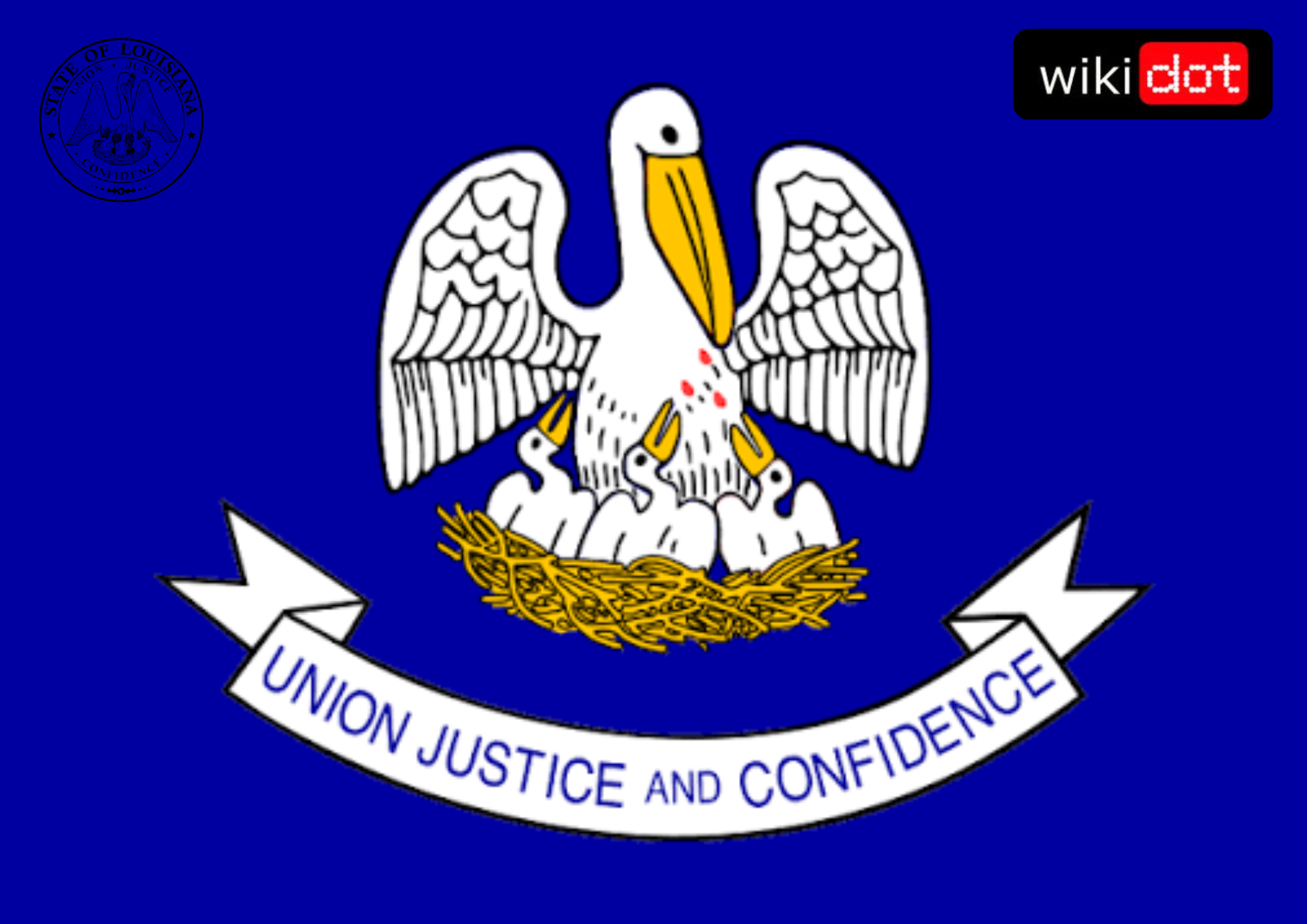
The Louisiana flag features a solid blue background. In the center, a white pelican sits above a nest, feeding three chicks. Below the birds, a white ribbon carries the state motto in blue letters: “Union, Justice and Confidence.”
According to the Louisiana Secretary of State’s official specifications, the flag contains two elements: a crest centered on a blue field. The design isn’t just decorative guesswork. State law spells out exact proportions, right down to where the crest sits on the fabric.
Simple palette. Clear symbol. No clutter. Honestly, it’s one of the more legible state flags in the country.
The Meaning Behind the Pelican
Here’s the twist: pelicans don’t actually do this.
Pelicans are known for their attentive nurturing of chicks, but they do not really tear at themselves to feed them — self-preservation is the norm in nature, not self-sacrifice. Ornithologist Mark Shields, who studies brown pelicans for Birds of North America, has said as much directly.
So where did this myth come from? The legend dates back to at least medieval times, likely from people misreading how pelicans actually feed their young. In reality, a pelican holds its bill against its chest to help chicks reach food stored in its throat pouch. From a distance, that looks a lot like self-wounding.
The image, known heraldically as a “pelican in her piety,” became a Christian symbol of sacrifice and charity long before Louisiana existed as a state. It’s a ubiquitous symbol of the Catholic Church, which explains why it resonated so strongly in a region shaped by French and Spanish Catholic settlers.
Biologically inaccurate? Yes. Symbolically powerful? Also yes. Flags are rarely about literal accuracy — they’re about the story a state wants to tell about itself.
A Brief History of the Louisiana Flag
Louisiana didn’t just wake up one day in 1912 and pick a flag. It took a while. A long while.
Ten Flags Over Louisiana
Before the current design, ten very different flags flew over Louisiana — Spanish, French, British, and eventually American. Ownership of the territory bounced around for over a century before it settled into U.S. hands.
The current flag design also reflects Louisiana’s French heritage, since the fleur-de-lis and the pelican both trace back to that colonial period. Even after becoming American territory, the state kept threads of its European past woven into its identity.
The Road to 1912
The pelican shows up early. William C. C. Claiborne, the first governor of the Orleans Territory, selected a pelican for the territory’s first seal, and it stuck around as an unofficial symbol for a century.
But nobody made it official right away. At least a half dozen different pelican designs decorated the state seal and flag over the years — some facing left, some facing right, some with three chicks, some with as many as eighteen. One version reportedly made the pelican look more like a vulture than a bird associated with charity.
That changed in 1912. The bill passed the Louisiana House of Representatives on June 13 by a vote of 71–1, and the flag was officially adopted July 1, 1912. It’s often called the “Pelican Flag” ever since.
Even then, lawmakers left the design pretty loose. The 1912 law only specified “the pelican feeding its young, in white in the center, with a ribbon beneath, also in white, containing in blue the motto of the State,” without locking in exact details.
The 2006 and 2010 Updates
That vagueness caused problems for nearly a century. Different agencies used different pelican drawings, and the design drifted all over the place.
Fittingly, an eighth-grader fixed it. An eighth-grader at Vandebilt Catholic High School in Houma brought the issue to his state legislator’s attention, and lawmakers responded. In April 2006, the Louisiana State Legislature passed a bill requiring three drops of blood to be depicted on the pelican, standardizing a detail that had been inconsistent for decades.
A few years later, the state refined the artwork further. Curtis J. Vann Jr., the designer of the latest seal and flag, added a golden-brown tuft of feathers atop the mother pelican’s crown to make the bird look more like a member of her species. That updated design became official in 2010, and it’s the version flown today.
Not every Louisianan loves it. Critics still argue the white-feathered pelican family resembles the wrong pelican species, since the state’s actual bird — the brown pelican — isn’t white at all. Flag design, it turns out, is never fully settled.
What the Colors Actually Mean
Flag symbolism tends to get exaggerated online, so here’s the grounded version, straight from historical sources close to the flag’s adoption.
- Blue — represents truth. The blue field signifies both truth and hope, and Louisiana is true to American ideals and optimistic as to her future, according to a historical account of the state’s flags.
- White — the pelican and ribbon appear in white, tying back to purity and the charitable symbolism of the pelican image itself.
- The motto — “Union, Justice and Confidence” reflects post-Reconstruction values: unity within the state and confidence in its future.
No hidden meanings, no secret codes. Just a state trying to say something true about itself in three words and one bird.
The Louisiana Pledge of Allegiance
Louisiana is one of the few states with its own flag pledge. Adopted in 1981, it reads: “I pledge allegiance to the flag of the state of Louisiana and to the motto for which it stands: A state, under God, united in purpose and ideals, confident that justice shall prevail for all of those abiding here.”
Louisiana schools often recite this alongside the U.S. Pledge of Allegiance — a small but distinctive piece of state identity most outsiders never hear about.
A Few Fun Facts
- Louisiana’s nickname, “the Pelican State,” comes directly from this flag and its long-running pelican symbolism.
- The pelican appears on the U.S. Mint’s Louisiana bicentennial quarter, alongside two other state symbols.
- During Louisiana’s Confederate era, the state briefly used a flag with a yellow star and thirteen stripes instead of the pelican design.
- The current flag’s proportions are exact: the flag itself measures 7 units tall by 11 units wide, according to official state specifications.
Where You Can See the Louisiana Flag Today
You’ll spot the flag outside the State Capitol in Baton Rouge, at courthouses, schools, and government buildings across the state. Official reproductions are available for purchase through the Louisiana Capitol Foundation, and the Secretary of State’s office maintains the authoritative digital artwork for anyone reproducing it commercially.
For the latest updates on Louisiana’s state symbols, elections, and archival history, the Louisiana Secretary of State’s Instagram account regularly shares historical posts, including flag and archive content worth following
Always double-check each platform’s current license terms before commercial use, since policies can change.
Final Thoughts
The Louisiana flag packs a surprising amount of history into a fairly simple design. A colonial-era symbol, a century of inconsistent artwork, an eighth-grader’s homework project, and one very dedicated (if biologically inaccurate) pelican — it’s all there in one blue field.
Next time you see that flag outside a courthouse or waving at a football game, you’ll know exactly why that bird looks like it’s having a rough day. And now you know the real reason it doesn’t.
Leave a Reply