
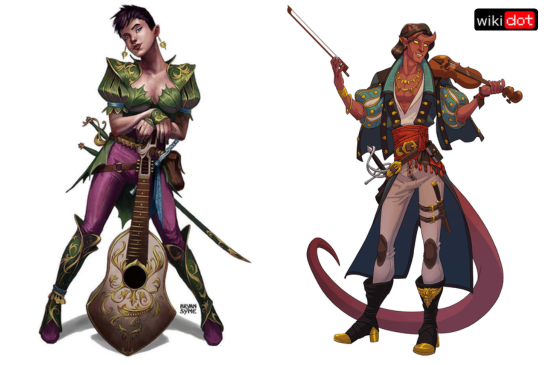
Bard 5e
If you love the idea of fighting monsters with a song instead of a sword, the Bard 5e class was built for you. Bards mix music, magic, and charm into one of the most flexible classes in Dungeons & Dragons.
This guide breaks down everything the Bard 5e class offers under the 2024 Player’s Handbook rules. You’ll learn how Bardic Inspiration works, how spellcasting fits into your build, and which subclass suits your playstyle.
What Is the Bard Class in D&D 5e?
The Bard is one of the twelve core classes in D&D 5e. According to Wizards of the Coast, Bards channel magic through music, dance, and verse, and they believe the multiverse itself was spoken into existence through ancient Words of Creation.
That lore explains why Bards feel different from other spellcasters. A Wizard studies. A Cleric prays. A Bard performs. This class rewards creativity, curiosity, and social skill just as much as combat power.
Bards fall into the “Expert” group alongside Rogues and Rangers. This means they lean heavily on skills outside of combat, while still holding their own in a fight through spells and support abilities.
Core Bard Traits
Every Bard starts with a shared foundation. At level 1, you gain:
- A d8 Hit Point Die
- Proficiency in one skill of your choice
- Proficiency with one musical instrument
- Training with light armor
These traits set the tone for the class. You’re not a heavy tank, but you’re not fragile either. You’re built to move, perform, and adapt.
Bardic Inspiration: The Heart of the Class
Bardic Inspiration is the signature feature of the Bard 5e class, and it got a meaningful upgrade in the 2024 rules.
Here’s how it works. As a bonus action, you can inspire a creature within 60 feet that can see or hear you. That creature receives a Bardic Inspiration die, starting at a d6. Once within the next hour, they can add that die to a failed ability check, attack roll, or saving throw, turning a loss into a win.
You can hand out Bardic Inspiration a number of times equal to your Charisma modifier, and you get all uses back after a long rest.
Why the 2024 Update Matters
In the earlier 2014 rules, Bardic Inspiration only lasted 10 minutes. Many players ended up holding onto their dice out of caution, afraid to waste them. The 2024 Player’s Handbook extends that window to a full hour. This small change makes the feature far more useful in and out of combat, and it encourages Bards to actually use their power instead of hoarding it.
The Bardic Inspiration die also grows stronger as you level up. It becomes a d8 at level 5, a d10 at level 10, and a d12 at level 15.
Bard Spellcasting Explained
Bards are full spellcasters, and their spell list is one of the most versatile in the game. At level 1, you know two cantrips, with Dancing Lights and Vicious Mockery commonly recommended as strong starting picks.
As you level up, you gain more spell slots and prepared spells. You can also swap cantrips whenever you gain a level, which gives Bards more flexibility than many other spellcasting classes.
Magical Secrets
Magical Secrets is one of the Bard’s most exciting features. In the current rules, whenever your number of prepared spells increases, you can choose spells from the Bard, Cleric, Druid, or Wizard spell lists. Those spells count as Bard spells for you going forward.
This gives Bards access to a massive well of magic, from divine healing to arcane utility, without ever needing to multiclass.
Bard Subclasses in 5e
At level 3, every Bard chooses a subclass, officially called a Bard College. The 2024 Player’s Handbook includes four options.
College of Lore
The College of Lore focuses on knowledge, versatility, and magical variety. Lore Bards gain extra Magical Secrets earlier than other subclasses and can use their skills to weaken enemies through cutting words. This subclass suits players who want maximum spell flexibility.
College of Valor
The College of Valor turns the Bard into a battle-ready performer. Valor Bards gain heavier armor and weapon training, plus the ability to add Bardic Inspiration dice to weapon damage. This is the pick for players who want a Bard that can stand in melee combat.
College of Glamour
The College of Glamour channels fey magic and charm. It grants access to spells like Charm Person and Mirror Image, along with abilities that can charm or frighten enemies during Enchantment or Illusion spells. This subclass fits a more social, manipulative playstyle.
College of Dance
College of Dance is the newest subclass, introduced in the 2024 rules after appearing in earlier playtest material. Dance Bards fight unarmored, using Dexterity and Charisma for both defense and unarmed strikes. Expending Bardic Inspiration lets them chain attacks together, making this subclass a strong pick for a mobile, martial-arts-inspired Bard.
Bard Features by Level
A few standout features arrive as your Bard grows:
- Level 2: Expertise doubles your proficiency bonus in two skills.
- Level 5: Font of Inspiration lets you regain Bardic Inspiration on a short rest, and you can spend a spell slot to recover a use.
- Level 9: Countercharm allows you to use a reaction to help disrupt Charmed or Frightened effects on yourself or nearby allies.
- Level 18: Superior Inspiration refreshes Bardic Inspiration when you roll initiative, arriving two levels earlier than in the previous ruleset.
- Level 20: Words of Creation grants permanent access to Power Word Heal and Power Word Kill, two of the most powerful spells a Bard can wield.
Is Bard a Good Class for Beginners?
Yes. The Bard 5e class works well for new players because it doesn’t lock you into one role. You can heal, support, fight, and talk your way through problems, all with the same character.
The tradeoff is that Bards ask you to think creatively. Success often depends on how well you use skills and spells together, not just how hard you hit in combat.
Final Thoughts on Bard 5e
The Bard remains one of the most rewarding classes in Dungeons & Dragons. The 2024 update makes Bardic Inspiration more forgiving, expands Magical Secrets, and adds the College of Dance as a fresh, mobile subclass option.
Whether you want to inspire your party with music, outsmart enemies with charm, or dive into melee with dance-based magic, the Bard 5e class gives you the tools to build the exact character you imagine.
Frequently Asked Questions (FAQ)
What is Bardic Inspiration in 5e? Bardic Inspiration is a Bard 5e feature that lets you grant an ally a bonus die they can add to a failed check, attack, or save. In the 2024 rules, that die lasts up to one hour.
How many Bard subclasses are in the 2024 Player’s Handbook? There are four official Bard subclasses: College of Lore, College of Valor, College of Glamour, and College of Dance.
What ability score do Bards use? Charisma is the Bard’s main spellcasting ability. It also determines how many times you can use Bardic Inspiration.
Are Bards good in combat? Bards can hold their own in combat, especially with subclasses like College of Valor or College of Dance, but their real strength lies in versatility and support.
What changed for Bards in the 2024 rules? Key changes include a longer Bardic Inspiration duration, earlier Expertise, an expanded Magical Secrets feature, the removal of Song of Rest, and the addition of the College of Dance subclass.
Leave a Reply