
The ocean hides more than fish and coral. In fantasy lore, it hides an entire civilization of elves. The sea elf is one of the most fascinating variations of the elven race, built for a life underwater rather than in the forest.
This article breaks down where the sea elf comes from, what makes it unique, and why fans keep returning to this aquatic legend. We will look at real sources from mythology and tabletop gaming, so you get facts, not guesswork.
What Is a Sea Elf?
A sea elf is a subrace of elf adapted to live in and breathe water. Writers also call this creature an aquatic elf or a water elf. Unlike common land-dwelling elves, sea elves spend most of their lives beneath the waves.Aquatic elves, also referred to as sea elves and water elves, were a subrace of elves adapted to living in and breathing water.
These beings share elven traits like long life and keen senses. But their bodies and habits shifted to match ocean life over time.
Sea elves show up across many fantasy universes. Dungeons & Dragons features them prominently. The Elder Scrolls has its own version, called the Maormer.The Elder Scrolls universe includes distinct elven races, among them the Sea Elves known as Maormer. Tabletop system GURPS also includes sea elf templates in its fantasy source books.
Where Does the Sea Elf Come From?
To understand the sea elf, you need to look at where elves themselves began.
Elves in Norse Mythology
Elves trace back to old Norse and Germanic folklore. Early texts split them into two groups: light elves and dark elves.In Germanic folklore, elves were classified as light elves, who were fair, and dark elves, who were darker than pitch. These early elves acted more like spirits than the tall, graceful figures we picture today.
Over centuries, storytellers reshaped elves again and again. J.R.R. Tolkien later gave elves the noble, immortal image most fantasy fans now recognize.Tolkien drew on the original light elves of Norse myth when he built his own version of the race. Sea elves grew out of this same tradition, adapted specifically for water.
Sea Elves in Tabletop Fantasy
In Dungeons & Dragons, sea elf lore has its own creative backstory. According to the game’s official material, sea elves fell in love with the ocean during the earliest days of the multiverse.Sea elves fell in love with the wild beauty of the ocean in the earliest days of the multiverse, while other elves traveled from realm to realm. While other elven groups wandered between worlds, sea elves chose to explore ocean currents instead.
Today, this lore places sea elf communities in ocean shallows and inside the Elemental Plane of Water, a realm built entirely of water.Today, sea elves live in small, hidden communities in the ocean shallows and on the Elemental Plane of Water.
In the Forgotten Realms setting specifically, sea elf mythology adds another layer. One legend claims their ancestors were once land-dwellers, saved from a shipwreck by a mysterious goddess.According to one aquatic elven myth, sea elves once dwelled on land, and their ancestors were part of an armada saved from a storm by an unknown goddess.
What Does a Sea Elf Look Like?
Sea elf appearance changes depending on the setting, but a few features repeat across most descriptions.
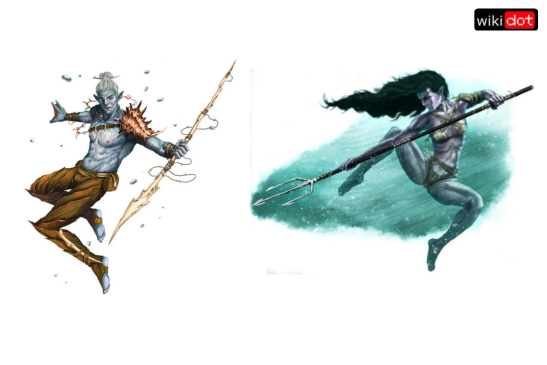
- Skin tone: Often green or blue, sometimes striped or mottled to match the surrounding water.Aquatic elves from different seas showed different coloring, with some having deep green skin mottled with brown and others having blue skin with white stripes.
- Hair: Thick, sometimes stringy, and often unusual colors like emerald green, silver, or blue.Aquatic elf hair was usually thick and somewhat stringy, appearing in shades like blue-green, emerald green, silver, or occasionally red.
- Eyes: Turquoise, black, white, or rarely silver.Aquatic elves could have eye colors including turquoise, white, black, blue, green, and rarely silver.
- Body: Webbed fingers and toes support fast, efficient swimming.Sea elves have amphibious bodies with webbed fingers and toes, along with a graceful and territorial nature.
Personality-wise, sea elves lean cautious. Most communities avoid contact with surface dwellers and stay loyal only to their own kind.Sea elves are reclusive and tend to distrust land-dwelling civilizations, including other breeds of elves.
Sea Elf Abilities in Dungeons & Dragons
Players who choose a sea elf character get a specific set of traits. These abilities reflect a life spent underwater.
Child of the Sea. Sea elves can breathe both air and water. They also resist cold damage, which helps in deep or icy waters.Sea elves can breathe air and water, and they have resistance to cold damage.
Swimming Speed. A sea elf swims as fast as it walks, usually 30 feet per turn.A sea elf’s walking speed is 30 feet, and it has a swimming speed equal to its walking speed. For comparison, that pace is close to how fast a real shark can swim.Sea elves are given a swimming speed of 30 feet, close to the 40-foot swimming speed of a shark.
Friend of the Sea. Sea elves can send simple messages to sea creatures using gestures and sound.Using gestures and sounds, sea elves can communicate simple ideas with any beast that has an innate swimming speed. This does not let them command animals, but it builds a working bond with marine life.
Combat Training. Many sea elves train with weapons suited for water combat, including spears, tridents, nets, and light crossbows.Sea elves have proficiency with the spear, trident, light crossbow, and net.
Darkvision and Trance. Like other elves, sea elves see in the dark and do not sleep the way humans do. Instead, they meditate for four hours to gain the same rest benefit.Elves meditate deeply for four hours a day instead of sleeping, gaining the same benefit a human gets from eight hours of sleep.
Sea Elves and Their Underwater Rivals
Sea elves rarely live in peace. Underwater fantasy worlds are crowded, and not every neighbor is friendly.
Their biggest rival is the sahuagin, a violent, shark-like humanoid race. The two sides have fought for generations.Sea elves live in a perpetual state of hostility with the sahuagin, monstrous fishy humanoids known as raiders of the ocean. Sahuagin are highly territorial and often start these conflicts.Sea elves and sharks are treated with more hostility than almost any other creature, and sea elves attack them on sight.
Sea elves keep a more distant relationship with tritons, another undersea race. Because sea elf society stays closed off, deep alliances with tritons rarely form.Sea elves are likely familiar with tritons, but their insular nature means they rarely build a strong relationship with them.
Why Sea Elves Remain Popular in Fantasy
Sea elves solve a problem most fantasy worlds face: oceans take up most of the map, yet few playable races call the water home. A sea elf fills that gap naturally.Sea elves fit into pretty much any world with an ocean and are easy to characterize using existing tropes of underwater dwellers.
Writers also enjoy building drama around isolation. A race that avoids the surface world creates instant tension whenever a sea elf finally does step onto land.Sea elves are not likely to venture to the surface at all, so seeing one on land marks a significant event.
Frequently Asked Questions
Is a sea elf the same as a mermaid? No. A sea elf is a full elf race, humanoid in shape, with legs rather than a fish tail. Mermaids belong to a separate mythological family.
Can sea elves live on land? Yes. Most sea elves can breathe air and water, so they can survive on land. However, they usually prefer staying near the ocean.
What games feature sea elves? Dungeons & Dragons, GURPS, and The Elder Scrolls (as the Maormer) all include sea elf or aquatic elf variants.
Do sea elves have magic? Sea elf magic depends on the game or story. In Dungeons & Dragons, sea elves can choose spellcasting classes just like any other elf subrace.
Are sea elves good or evil? Sea elves are generally neutral and cautious rather than good or evil. Their loyalty stays close to their own community first.
Final Thoughts
The sea elf blends ancient elven mythology with a fresh, ocean-based identity. From Norse folklore roots to modern tabletop gaming, this creature keeps adapting while holding onto its core traits: caution, grace, and a deep bond with the sea.
Leave a Reply