
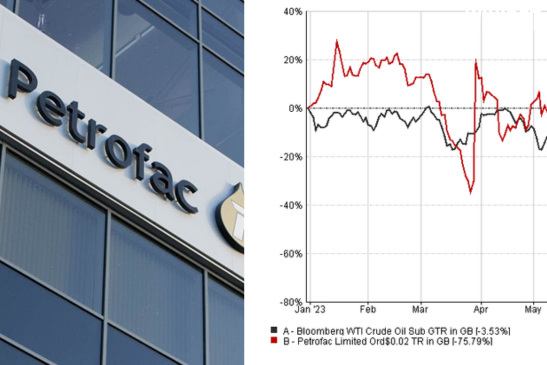
Many investors still search for the Petrofac share price, hoping to track this once-major name in the energy services sector. But the real story behind that search is more serious than a simple price check.
Petrofac Limited, the London-listed oil and gas engineering group, no longer trades on the London Stock Exchange. Its shares were cancelled in October 2025 after the company entered administration. If you are looking for a live Petrofac share price today, here is what you actually need to know.
Is Petrofac Still Trading on the Stock Exchange?
No. Petrofac shares stopped trading on the London Stock Exchange on 28 October 2025. The company confirmed the cancellation of its listing that same morning, at 8:00 a.m. London time.Petrofac Limited (in administration) shares were expected to be cancelled, in each case with effect from 8:00 a.m. London time on 28 October 2025.
Some financial data platforms still display an old figure, such as 3.98p, next to Petrofac’s ticker (PFC). This number reflects the last recorded price before trading stopped. It is not a live or current market price. Petrofac has no active share price today because the stock is no longer listed anywhere.
This matters for search engines and readers alike. Anyone relying on outdated data could easily assume Petrofac shares are still tradable. They are not.
Why Did Petrofac Shares Get Delisted?
The delisting followed a long period of financial strain. Several events led to this outcome.
A Restructuring Plan That Fell Apart
By late 2024, Petrofac had proposed a court-approved restructuring plan. The plan aimed to address debts owed to several creditor groups, including senior secured lenders and shareholders.
In May 2025, the High Court sanctioned this restructuring plan. However, two of Petrofac’s joint venture partners, Samsung and Saipem, challenged the decision. The English Court of Appeal overturned the High Court’s sanction of Petrofac’s plans, ruling in favor of the appeal brought by Samsung and Saipem.
The court found a fairness problem at the center of the deal. The Court found that the plans allocated over two-thirds of the value generated by the restructuring to the providers of new money, giving them a return of more than 200% on their investment. Judges ruled this allocation was not fair to other creditors.
The Dutch Contract That Made Things Worse
Petrofac was already working to find an alternative path after the court ruling. Then a major contract collapsed. Dutch grid operator TenneT cancelled Petrofac’s role in a €2 billion offshore wind project in the Netherlands. This project had been central to the company’s restructuring strategy.
The loss of this contract removed a critical source of future cash flow. Petrofac said the cancellation made its near-final restructuring plan no longer workable.
Administration Becomes the Only Option
On 27 October 2025, Petrofac’s board applied to the High Court of England and Wales to appoint administrators. This was described as a targeted administration of the Group’s ultimate holding company only, with the Group’s operations continuing to trade.
The very next day, shares stopped trading. A few weeks later, in November 2025, a subsidiary called Petrofac International Limited also entered the administration process. This subsidiary historically managed much of the Group’s Engineering & Construction activity across the Middle East and North Africa.
What Does “No Residual Value” Mean for Shareholders?
Before the final collapse, Petrofac had already warned shareholders about the outcome. The company confirmed that its restructuring would result in no residual value being retained by existing shareholders.
In plain terms, this means existing shareholders lose their entire investment. Once a restructuring plan wipes out equity value, and the parent company enters administration, ordinary shares typically become worthless. This is standard practice under UK insolvency law when creditor claims outweigh whatever value remains in a business.
Anyone still holding Petrofac shares should treat them as having no market value under current conditions.
Did Petrofac’s Business Operations Stop?
No, and this is an important distinction. The administration targeted only the parent holding company, not the operating businesses beneath it.
Petrofac’s operating subsidiaries continued working across multiple regions. The company holds active projects worth more than $5 billion across the Gulf Cooperation Council countries and North Africa, including contracts with ADNOC Gas and Kuwait Oil Company.
However, the disruption still had real consequences for staff. Around 2,000 jobs in Aberdeen, Scotland, faced risk as part of the fallout. Petrofac employs roughly 7,300 people worldwide, and management has stated its goal is to protect operational capability wherever possible.
Background: Why Petrofac Struggled in the First Place
Petrofac was founded in 1981 and listed on the London Stock Exchange in 2005. For years, the company built a strong reputation across engineering, procurement, and construction (EPC) projects in oil, gas, and petrochemical infrastructure.
Its troubles began years before the final collapse. In 2017, the UK’s Serious Fraud Office opened an investigation into bribery allegations connected to Middle East contracts. This investigation damaged the company’s reputation and made new project bidding harder.
Rising borrowing costs and shrinking profit margins added further pressure over time. Combined with the loss of major contracts, these factors pushed the company toward insolvency.
What Happens Next for Petrofac?
Administrators are now working with Petrofac’s executive management. Their goal is to preserve as much value as possible across the group’s trading businesses.
The company continues to explore alternative restructuring routes and M&A solutions with key creditors, including its Ad Hoc Group of Noteholders. Lenders under the Revolving Credit Facility and Term Loan have also extended maturities on a rolling basis, giving the business breathing room while new options are assessed.
For now, there is no confirmed timeline for a relisting or a new ownership structure. Updates typically come directly through Petrofac’s official newsroom, so that remains the most reliable source for current developments.
Wider Impact on UK Restructuring Law
Petrofac’s case has become a landmark ruling beyond its own business. Legal experts note that the Court of Appeal decision changed how future restructuring plans must handle fairness between creditor groups.
Companies attempting similar restructuring plans now face closer scrutiny. Courts expect stronger evidence that value gets shared fairly, especially when new investors receive large returns. Several law firms have already flagged this shift as a lasting legacy of the Petrofac case, shaping how UK companies approach financial restructuring going forward.
Final Thoughts
Searching for the Petrofac share price today leads to an important reality check. The stock no longer trades on any public exchange, and the parent company remains in administration. Existing shareholders have no residual value in their holdings.
Still, Petrofac’s operating businesses continue working on major energy projects across the Gulf and North Africa. The next chapter depends on ongoing talks between administrators, creditors, and potential buyers. Anyone following this story should rely on verified sources, such as Petrofac’s official announcements or established financial news outlets, rather than outdated stock trackers.
Frequently Asked Questions
Is Petrofac still listed on the London Stock Exchange? No. Petrofac’s shares were cancelled from trading on 28 October 2025, following the company’s move into administration.
What is Petrofac’s current share price? Petrofac has no current or live share price. Any figure shown on financial websites reflects the last trade before delisting, not real-time data.
Why did Petrofac go into administration? A UK Court of Appeal ruling overturned Petrofac’s restructuring plan in July 2025. Soon after, Dutch grid operator TenneT cancelled a major offshore contract, removing a key funding source and forcing the company toward administration in October 2025.
Will Petrofac shareholders get any money back? Petrofac confirmed that its restructuring process leaves no residual value for existing shareholders, meaning current shares hold no recoverable value under present conditions.
Is Petrofac still operating as a business? Yes. Petrofac’s operating subsidiaries continue trading and delivering projects, particularly across the Middle East and North Africa, even though the parent holding company is in administration.
Could Petrofac return to the stock market in the future? There is no confirmed plan for relisting. The company is currently focused on restructuring and exploring merger or acquisition options with its creditors.
Leave a Reply