
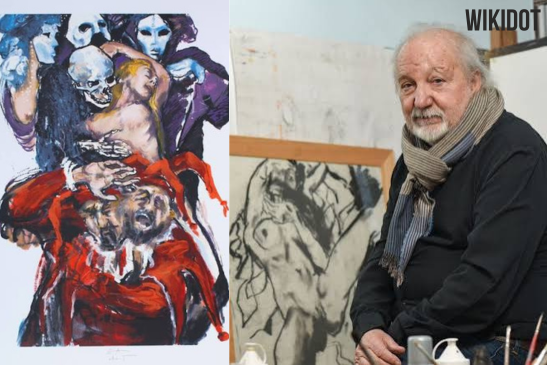
He paints. He designs stage sets. He directs opera. He teaches. For over five decades, Zlatko Kauzlarić Atač has moved between the canvas and the theatre without ever really leaving either one behind.
This article walks through his life, his art, his work in Croatian theatre, and the honors he has earned along the way. Every detail here comes from verified biographical sources, museum archives, and published interviews, which are all linked at the end.
Who Is Zlatko Kauzlarić Atač?
Zlatko Kauzlarić Atač was born on June 30, 1945, in Koprivnica, Croatia. His parents, Ivan Kauzlarić and Štefanija Forenbacher, raised him in a small town that would later name him an honorary citizen.
He finished high school in Koprivnica in 1964. That same year, he enrolled at the Academy of Fine Arts in Zagreb, where his artistic path truly began.
Interestingly, painting was not his first love. As a child, he gravitated toward acting and recitation. He even performed with the City Amateur Theatre in Koprivnica, staging his first solo exhibition of drawings and paintings while still in school, in 1961.
Education and Early Career
At the Academy of Fine Arts, Atač studied under Professor Miljenko Stančić and graduated in 1968. During his studies, he also threw himself into student theatre as an actor, director, musician, and mime performer.
After graduation, he joined the postgraduate master workshop of painter Krste Hegedušić, working alongside him from 1968 to around 1974. This period shaped his early painting style, blending expressive figuration with socially engaged themes.
In 1973, at just 27 years old, he became an assistant at the Academy of Fine Arts in Zagreb. He never really left. He rose through the ranks to become a full professor, and he later served as dean of the same academy. Since 1989, he has also taught at the Design Studio of the Faculty of Architecture.
The Biafra Art Group
In the early 1970s, Atač joined a group of young painters called Biafra. Founders Stjepan Gračan, Branko Bunić, Miro Vuco, and Ratko Petrić named the group after the Nigerian province that suffered a devastating war and famine in the late 1960s.
The group was active in Zagreb from around 1970 to 1978. Members rejected abstract art and pushed instead for expressive, critical figuration. They staged exhibitions and public actions in the streets, often confronting politics, bureaucracy, and social hardship head-on.
This period left a mark on Atač’s work. His paintings from these years explore human vulnerability, power, and repression, often through raw, expressive figures rather than polished, idealized forms.
Atač the Painter
Atač’s painting career centers on the human figure. Portraits and nudes dominate his output, and his brushwork often carries movement and emotional weight rather than strict realism.
Early works like Autoportret s mačkom and Rendez-vous (1968), Povratak (1969), and Nas dvoje (1972) reflect an intimate, personal style. Later, his themes grew more socially engaged, echoing the influence of his mentor Hegedušić.
He has held around eighty solo exhibitions in Croatia and abroad. His paintings have also appeared in major group shows, including the Zagreb Salon, the Drawing Triennial, and exhibitions in Florence, Belgrade, and Mainz.
His painting awards include the Grand Prize of the Zagreb Salon and multiple prizes from the Drawing Triennial and the Zagreb Graphic Art Exhibition.
Atač the Scenographer and Theatre Director
Painting is only half the story. Since the 1970s, Atač has worked intensively as a scenographer and costume designer for theatre, contributing to more than 150 stage productions in Croatia and abroad.
His theatre work spans set design, costume design, and occasional directing. He has also collaborated on several film and television projects.
His best-known achievement as a director came in 1996, when he staged Verdi’s opera Rigoletto at the Croatian National Theatre Ivan pl. Zajc in Rijeka. The production earned wide acclaim and several awards, and he later restaged it at the Croatian National Theatre in Osijek in 1997.
Alongside his stage work, he created a series of portraits of actors, playwrights, and directors connected to Croatian theatre. This series bridges his two disciplines, portraying the people who bring the stage to life.
Public Art and Visual Interventions
Beyond galleries and theatres, Atač has also created visual interventions in public spaces around Koprivnica. His projects include work at a local brewery, a recreation center owned by Podravka, a Podravka office building, and the town’s new hospital.
These pieces show a different side of his practice: art designed for everyday public spaces rather than curated exhibition rooms.
Awards and Recognition
Atač’s career has earned him significant recognition in Croatia and internationally. Key honors include:
- The Order of Danica Hrvatska with the Face of Marko Marulić, awarded in 1995 for contributions to culture
- The City of Koprivnica Lifetime Achievement Award, received in 2004
- The Chevalier de l’Ordre des Arts et des Lettres, awarded by France’s Ministry of Culture
- Honorary citizenship of the City of Koprivnica, granted in 2018
- Multiple Theatre Critics’ Association awards for his scenography, spanning the late 1970s through the late 1980s
- The Croatian Actors’ Award and the “Marul” Award, both tied to his theatre work
The Monograph: Slikar u kazalištu
In recent years, Atač’s contribution to Croatian culture was documented in a major monograph titled Slikar u kazalištu (“Painter in the Theatre”). The Croatian Academy of Sciences and Arts (HAZU) and the Croatian Association of Applied Arts (ULUPUH) published the book.
The monograph runs to 472 large-format pages and includes roughly 1,000 visual reproductions. Theatre scholar Martina Petranović wrote the central study on his stage work, while art historian Željka Čorak contributed the closing chapter on his painting career.
The book was later shortlisted among the 18 best-designed Croatian books for 2020, in a national competition tied to the international Best Book Design from all over the World award.
Recent Exhibitions
Atač’s work continues to reach new audiences. Between late 2021 and early 2023, the Mimara Museum in Zagreb hosted a virtual exhibition titled Od crteža do scene (“From Drawing to Scene”), tracing his journey from early sketches to full stage productions.
In January 2019, the University North campus in Koprivnica also hosted a dedicated exhibition of his paintings, drawing local and academic audiences to his hometown region.
A Life Still in Motion
Atač has faced serious health challenges in recent years, including heart complications, yet he has continued to work through them. In interviews, he has spoken candidly about balancing a demanding creative life with the realities of aging.
That resilience mirrors his career. Across painting, theatre, and teaching, Atač has rarely paused for long.
Frequently Asked Questions
Who is Zlatko Kauzlarić Atač? He is a Croatian painter, scenographer, costume designer, and theatre director, born in 1945 in Koprivnica. He is best known for figurative painting and his scenography for Verdi’s Rigoletto.
What is Atač best known for? He is best known for two things: his figurative paintings of portraits and nudes, and his stage design work, particularly his 1996 production of Rigoletto at the Croatian National Theatre in Rijeka.
Did Atač teach at an art academy? Yes. He became an assistant at the Academy of Fine Arts in Zagreb in 1973 and later became a full professor. He also served as dean of the academy for a period.
What is the Biafra art group? Biafra was a Zagreb-based group of young painters active from around 1970 to 1978. The group rejected abstract art in favor of expressive, socially critical figurative painting, and Atač was one of its members.
Is there a book about his life and work? Yes. Slikar u kazalištu (Painter in the Theatre) is a 472-page monograph published by HAZU and ULUPUH, covering both his painting career and his theatre work.
Is Zlatko Kauzlarić Atač an honorary citizen? Yes. The City of Koprivnica granted him honorary citizenship in 2018, recognizing his contribution to the city’s cultural identity.
Leave a Reply