
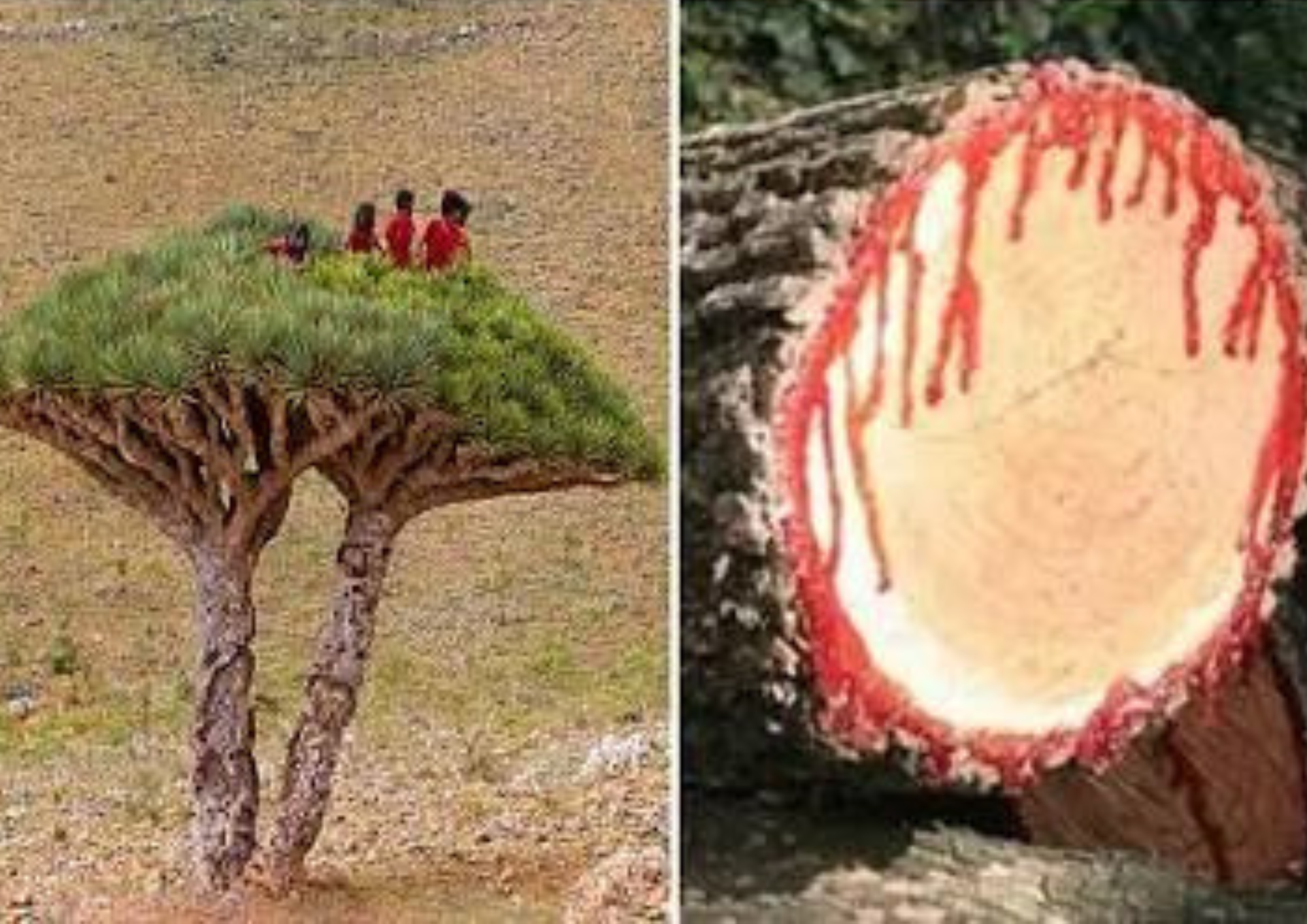
Dracaena Cinnabari — The Dragon Blood Tree?
There are strange trees. And then there is Dracaena cinnabari.
When you first see a photo of it, your brain tries to classify it. Is it a mushroom? A parasol? A very dramatic art installation? Nope. It is a real, living tree — and it bleeds red.
Dracaena cinnabari, commonly known as the Dragon Blood Tree, is an evergreen tree native exclusively to the Socotra Archipelago, a group of islands that belongs to Yemen, sitting in the Arabian Sea. The name “cinnabari” comes from the ancient word cinnabar, referring to the vivid crimson color of its sap. And yes — when you cut its bark, it oozes a thick, blood-red resin. Hence the name. No mythology needed. Nature did the work.
According to Wikipedia’s detailed entry on Dracaena cinnabari, this tree is also the national tree of Yemen — a title it wears with all the dramatic flair you’d expect.
Where Does the Dragon Blood Tree Grow?
The Dragon Blood Tree grows in one place on Earth: Socotra Island, the largest of the four Socotra islands in the Indian Ocean.
Socotra itself is no ordinary island. It looks like it was plucked from a science fiction film set. The island sits roughly 240 kilometers east of the Horn of Africa and 380 kilometers south of the Arabian Peninsula. UNESCO recognized it as a World Natural Heritage Site in 2008 — and for good reason. The island has around 700 plant species found nowhere else on Earth.
The Dragon Blood Tree thrives at elevations between 300 and 1,500 meters, mostly on limestone plateaus. The largest and best-preserved forest of D. cinnabari sits on the Rokeb di Firmihin plateau, covering approximately 540 hectares. According to research published on ResearchGate, this woodland is considered one of the oldest surviving endangered forest communities on Earth.
What Makes This Tree Look So Alien?
Short answer: everything.
The Dragon Blood Tree has a perfectly flat, dense, umbrella-shaped canopy sitting atop a thick, branching trunk. It looks less like a tree and more like someone opened a giant green parasol and stuck it in the ground.
This shape is not a quirk of evolution — it is a survival strategy. Socotra is hot, arid, and harsh. The flat canopy does three clever things:
- It collects fog. Socotra gets much of its moisture from sea mists, not rainfall. The dense leaf mass intercepts fog droplets and channels water down to the roots. Research from CityC acti’s comprehensive Dracaena guide confirms that fog interception contributes substantially to the local water budget in areas with dense Dragon Blood Tree growth.
- It creates shade. The broad canopy shades the soil beneath it, reducing evaporation and keeping the ground moist for the tree’s own seeds.
- It reduces water loss. Leaves only grow at the tips of the youngest branches — and they are shed every three to four years as a group, not gradually.
This is a tree that has spent millions of years optimizing. It did not arrive at this shape by accident.
The Famous Red Resin — Dragon’s Blood
Let’s talk about the blood.
When the bark or branches of Dracaena cinnabari are cut, a deep crimson resin oozes out and dries into a vivid red substance known as “dragon’s blood.” It is striking enough that ancient civilizations — Romans, Egyptians, Arabs — built entire trade networks around it.
Here is a quick breakdown of what dragon’s blood resin has been used for across history and culture, based on verified sources:
- Medicine: Indigenous Socotrans use it as a traditional remedy. The root yields a gum-resin used in gargle water as an astringent and in toothpaste. The leaves have carminative properties.
- Dye: Around the Mediterranean, it has been used as a fabric dye for centuries.
- Varnish and art: Dragon’s blood resin is believed by historians to be behind the extraordinarily intense color of Stradivarius violins, the legendary 17th-century Italian instruments. (Yes, really. Your violin might be related to a bleeding tree.)
- Cosmetics: Socotrans have historically used it as lipstick and for dyeing wool.
- Incense and ritual: Many cultures used it in ceremonies and spiritual practices.
Scottish botanist Isaac Bayley Balfour officially described and named the species in 1882, and even classified three grades of dragon’s blood resin — tear-like pieces being the most valuable. According to Gardenerdy’s fact file, dragon’s blood had already found mention in a 1st-century Roman Periplus, so this tree’s reputation is ancient.
Dracaena Cinnabari: A Botanical Oddity
Here is where it gets properly nerdy — in the best way.
D. cinnabari is a monocot plant. That means it is more closely related to grasses, palms, and lilies than to most trees you see every day. Most monocots do not grow like trees. They do not have woody trunks. They cannot thicken with age.
The Dragon Blood Tree does not care about these rules.
Unlike typical monocots, Dracaena cinnabari undergoes secondary growth — a rare ability that lets its trunk thicken over time, giving it a tree-like structure. It even produces growth zone patterns that resemble tree rings, though these cannot reliably indicate age since they form from irregular vascular bundle patterns rather than seasonal cycles.
The tree belongs to the Asparagaceae family — the same family as asparagus, agaves, and hostas. So the next time you eat asparagus, you are technically eating a distant cousin of a tree that bleeds.
How Old Do These Trees Get?
Old. Very old.
Age estimation in Dragon Blood Trees is tricky because the growth rings do not work the same way as in dicot species. Researchers rely on branching patterns and environmental records. According to a study reviewed by IntechOpen, the mean age of trees in the Firmihin forest is estimated at around 300 years, with some individuals likely exceeding 500 years.
Mature specimens reach heights of up to 10 to 12 meters (33 to 40 feet) with a canopy spread that can match the height.
Conservation Status: Is the Dragon Blood Tree Endangered?
Here is the part that matters most.
The Dragon Blood Tree is currently listed as Vulnerable (VU) on the IUCN Red List of Threatened Species. That is one step below Endangered — and the situation is getting more serious, not less.
According to research published through ResearchGate and IntechOpen, the total estimated population of D. cinnabari is approximately 80,134 individuals, spread across fragmented sub-populations. Some of those sub-populations have projected extinction timelines of just 31 years if trends continue.
The main threats facing the Dragon Blood Tree include:
- Climate change — decreasing monsoon mist and rainfall means less moisture for the trees
- Overgrazing — goats and livestock eat young seedlings, destroying natural regeneration
- Lack of regeneration — fewer seedlings are surviving to maturity in the wild
- Road construction — infrastructure development encroaches on natural habitat
- Resin over-harvesting — unsustainable tapping damages the trees
The species is listed on Appendix II of CITES (Convention on International Trade in Endangered Species), which provides some protection against commercial over-exploitation. But protection on paper and protection on the ground are not always the same thing.
The Kew Science Plants of the World Online database flags the predicted extinction risk as threatened, underlining that the current Vulnerable listing may not fully capture the urgency.
Dracaena Cinnabari vs. Dracaena Draco — What’s the Difference?
A common point of confusion. Both trees look similar. Both produce red sap. Both have umbrella canopies. They are related, but they are not the same species.
- Dracaena cinnabari — native to Socotra Island, Yemen. More isolated, more unique, more threatened.
- Dracaena draco — native to the Canary Islands, Madeira, and Cape Verde.
The key difference is habitat and conservation status. D. cinnabari‘s extreme isolation on Socotra makes it more vulnerable to extinction. According to Gardenia.net’s detailed plant guide, both share drought tolerance and slow growth — but D. cinnabari‘s ecological situation is considerably more fragile.
Can You Grow a Dragon Blood Tree at Home?
Yes — with serious patience and the right conditions.
D. cinnabari is not a fast grower. It is not going to fill your living room in two years. But it can be grown indoors as a novelty plant, especially in warmer climates. Here are the basics:
- Light: Bright, indirect sunlight. A south-facing window with a sheer curtain works well.
- Temperature: Ideally 25–30°C. It dislikes cold. Temperatures below 10°C can damage it.
- Soil: Well-draining, limestone-based. Do not overwater — this tree is drought-tolerant for a reason.
- Propagation: Primarily from seeds. Cuttings are possible but slower and less reliable.
Growing one at home is also, in a small way, a conservation act. Every plant that exists outside its threatened natural habitat is insurance against total extinction.
Why the Dragon Blood Tree Matters Beyond Socotra
The Dragon Blood Tree is not just a botanical curiosity. It is an ecological keystone.
The dense forests of D. cinnabari on Socotra support numerous other endemic plant and animal species. Lose the trees, and you do not just lose one species — you lose an entire interconnected ecosystem.
The Socotra Archipelago is recognized as part of the Horn of Africa biodiversity hotspot and designated as a UNESCO World Heritage Site. It is simultaneously a Centre of Plant Diversity and an Endemic Bird Area. The Dragon Blood Tree sits at the center of all of it.
Researchers at ResearchGate describe conservation of D. cinnabari as an umbrella strategy — protecting it protects everything that depends on it.
Key Facts at a Glance
| Feature | Detail |
|---|---|
| Scientific Name | Dracaena cinnabari Balf.f. |
| Common Name | Dragon Blood Tree, Socotra Dragon Tree |
| Family | Asparagaceae |
| Native Range | Socotra Archipelago, Yemen |
| Height | Up to 10–12 meters |
| Estimated Age (wild specimens) | 300–500+ years |
| IUCN Status | Vulnerable (VU) |
| CITES Listing | Appendix II (2010) |
| UNESCO Status | Socotra listed as World Heritage Site (2008) |
| National Tree of | Yemen |
Final Thoughts
Dracaena cinnabari is the kind of tree that makes you feel like the natural world is still full of surprises — because it is.
It grows in one tiny corner of the Arabian Sea. It bleeds red. It looks like something from a fantasy novel. It fed ancient trade routes, colored Renaissance violins, and still sustains an entire island ecosystem today.
And it is quietly disappearing.
Knowing about this tree is the first step. Supporting verified conservation organizations working in Socotra — like the IUCN Species Survival Commission and Kew Royal Botanic Gardens — is the next one.
Leave a Reply